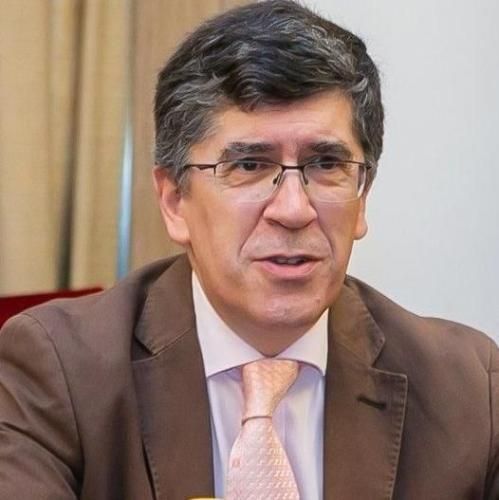
Carlos Vidal Prado
Catedrático de Universidad
Departament: Derecho Constitucional
Faculty: Facultad de Derecho
Area: Constitutional Law
Research group: CIPT Constitución, Integración, Poder y Territorio
Research group: FUND-RIGHTS Derechos Fundamentales Multinivel / Multilevel Fundamental Rights
Email: cvidal@der.uned.es
Personal web: https://www.uned.es/universidad/docentes/derecho/carlos-j...
Doctor by the Universidad de Navarra with the thesis El sistema electoral español una propuesta de reforma 1993. Supervised by Dr. Antonio Torres del Moral.
Full Professor of Constitutional Law at the UNED (National Distance Education University) since March 2017. PhD Program Lecturer at the University of Verona since June 2009. Postgraduate Professor at the University of Alcalá de Henares since March 2003 and at the Master’s Program in Constitutional Law and Political Science of the Center for Political and Constitutional Studies (CEPC) since 2018. He has previously served as Professor of Constitutional Law at the University of Navarra from 1990 to 2000 and at UNED since 1997, obtaining tenure as Associate Professor on January 21, 2003. He has been a Visiting or Guest Professor at the Universities of Cologne and Göttingen (Germany), Verona and Siena (Italy), and at the Autonomous University Gabriel René Moreno (Santa Cruz de la Sierra, Bolivia). He is Executive Director of the Journal of Political Law (Revista de Derecho Político) (indexed in JCR, Scopus, and bearing the FECYT quality seal). He was a Research Fellow of the Alexander von Humboldt Foundation (2005–2006). Corresponding Member of the Royal Academy of Jurisprudence and Legislation of Spain. Researcher at the Institute of Educational and Social Studies, part of the European Foundation Society and Education. He has carried out research stays at the Institute of Public Law of the University of Rome “La Sapienza”, the Italian Constitutional Court, the Universities of Siena and Verona, the Institute for German and European Science Law (University of Cologne), the Chair of Public Law at the University of Göttingen, the Chair of Public Law at the University of Regensburg, and the Institute for Energy Law at the Faculty of Law of the University of Bochum. Since March 1996, he has participated as a researcher in 26 research projects—at regional, national, and European levels—on educational rights, electoral law, and the relationship between constitutional and EU jurisprudence, serving as Principal Investigator (PI) in five of them. The most recent include: Educating in Values, Building Citizenships (PID2021-127680OB-I00, 2020 call), Teaching the Constitution, Educating in Democracy (RTI2018-096103-B-I00, 2018 call for “R&D Research Challenges Projects”), and The Reform of Public Administrations in Spain: Analysis of Measures Implemented during the 2011–2015 Legislature, funded by INAP under its permanent research project call with a €10,000 grant, completed in May 2017. He is the author of more than 150 publications across several fields: the electoral system, fundamental rights (especially educational rights), relations between national jurisdictions and the Court of Justice of the European Union, and the Spanish autonomous state. He has written numerous monographs, the most recent being: The Spanish Central Electoral Board: Analysis of Some Recent Decisions (2020), Teaching the Constitution, Educating in Democracy (co-edited with J. Díaz Revorio, 2021), and Educating in Values, Building Citizenships (co-edited with Javier Díaz Revorio, 2025). He has supervised 15 doctoral theses and sixty master’s dissertations. He serves as a reviewer for various academic journals in the field—including REDC and REP—as well as for monographs submitted to the CEPC and the Spanish Parliament (Cortes Generales). He is also an evaluator of faculty and degree programs for ANECA, the Madri+d Foundation, and the Andalusian Agency for Knowledge, as well as for ANVUR (Italy). He has held various public administration positions, most of them in the educational and university sector. He holds four six-year research periods (sexenios)—the most recent valid through 2023—and six five-year teaching periods (quinquenios).